
Heuristics in Action
What is this course about?
You know something is off. The navigation feels wrong. Users keep getting stuck in the same place. The content doesn't hang together. But when someone asks you to explain what the problem is, or back up your critique with something more than gut instinct, you come up empty.
Heuristics give you the language and the structure to do that. They are a set of guiding principles you can use to evaluate existing systems, plan new ones, coach your team, and run a critique that actually goes somewhere. This course teaches you how to put them to work, not just what they are.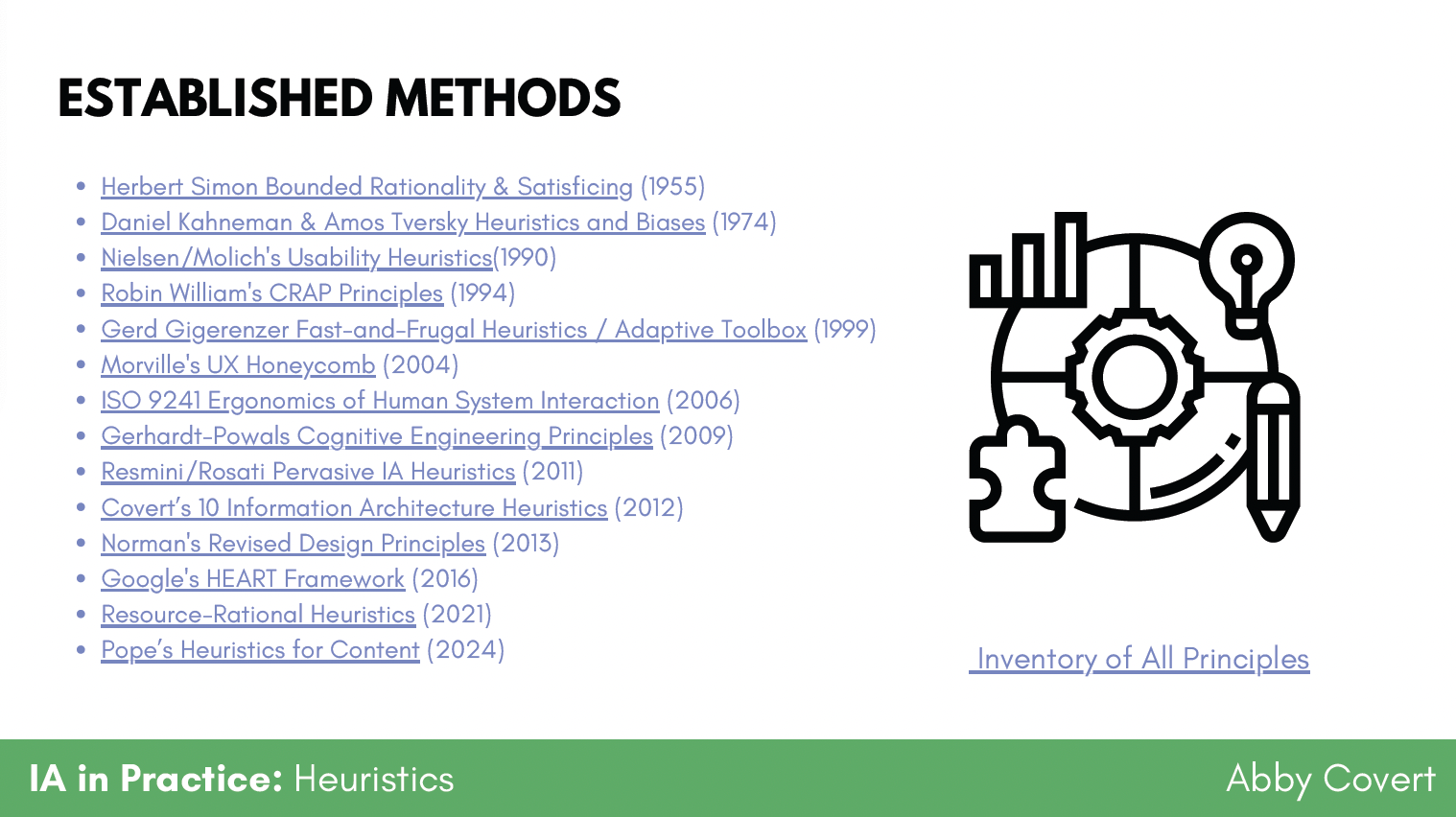 Course Example Slide 1
What is the learning objective of this course?
By the end of this course you will be able to run a heuristic evaluation from start to finish and communicate what you found in a way that moves a project forward.
That means you will be able to:
- Recognize which heuristic frameworks are most relevant to your work, from Nielsen/Molich and Morville to Covert's 10 IA Heuristics and beyond
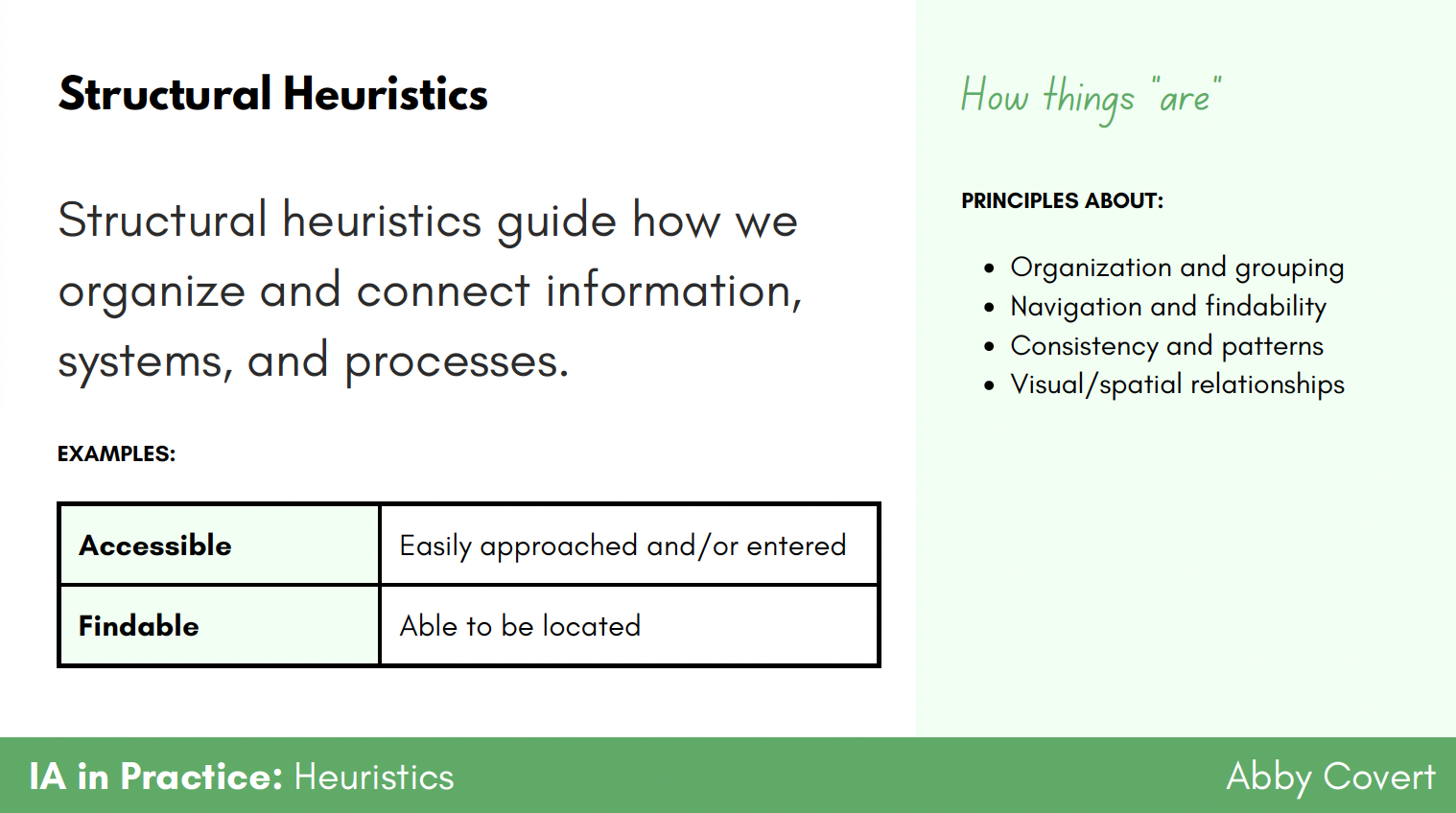
- Tell the difference between structural, experiential, and procedural heuristics, and know when each type of thinking applies
- Build a heuristic rubric tailored to a specific user and task scenario
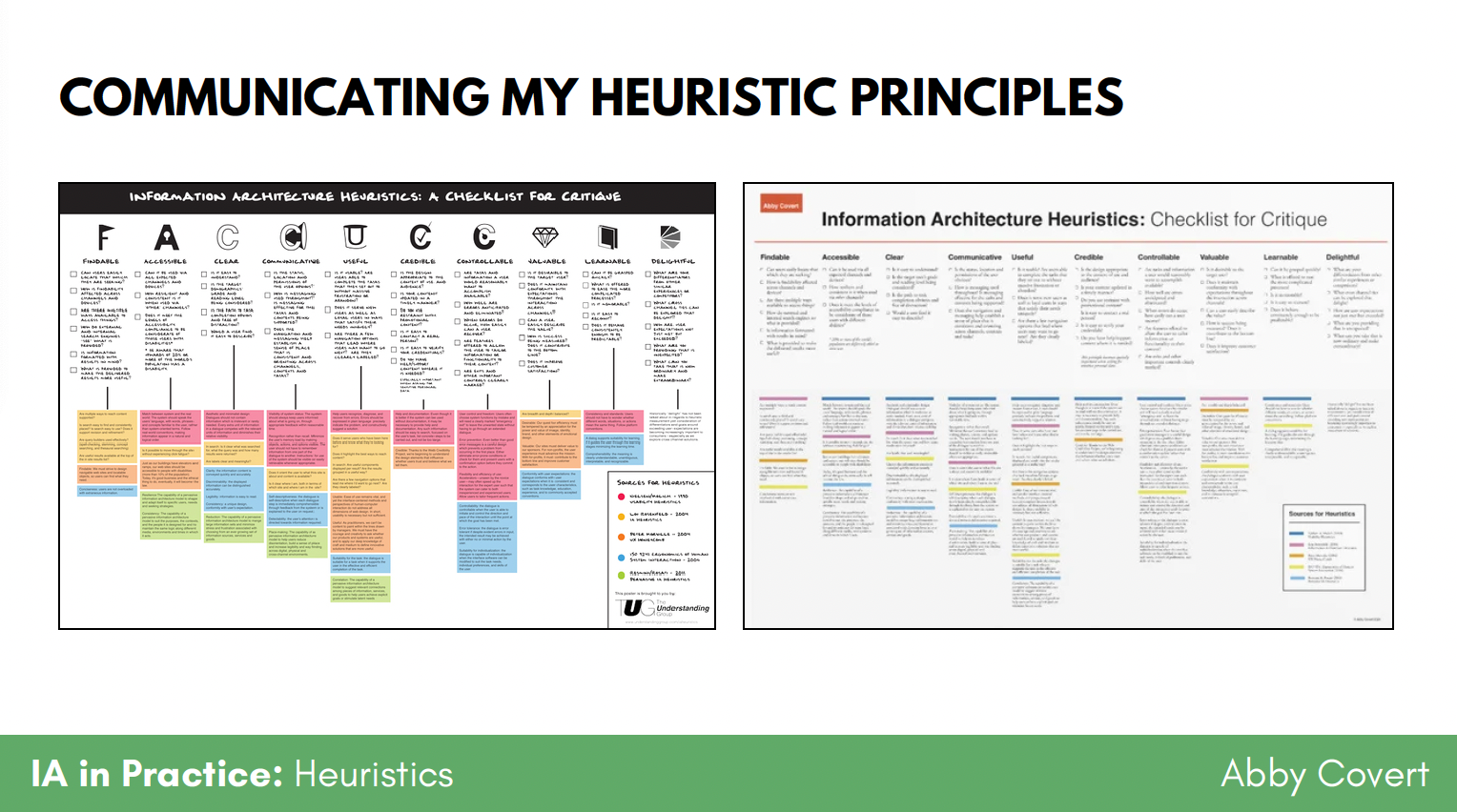
- Document findings in a clear, defensible format using checklists, screenshots, top-line reports, or full written evaluations
- Integrate heuristic thinking into how you critique, plan, and QA information systems on an ongoing basis
 Course Example Slide 2
How is this course taught?
This is a self-paced eCourse built from a live workshop recording. Here's what's included:
- Workshop recording: A hands-on session led by Abby Covert walking through the full heuristics process, including live examples and a peer practice exercise. Run time is approximately 90 minutes.
- Slide deck download: The full presentation used in the workshop, including Covert's 10 IA Heuristics, the heuristic rubric template, and examples of evaluation formats.
- Rubric template: A ready-to-use template for scoping and running your own heuristic evaluation.
 Course Example Slide 3
Who was this course designed for?
- You work in information architecture, UX, content design, product, or a related field
- You have been doing this work for a while, but evaluating systems with rigor and shared language is still a gap
- You can spot a problem quickly but struggle to explain it in terms that stick with stakeholders
- You are often the one pointing out structural or navigational issues that others miss
- You want to bring more consistency to how your team critiques and reviews work
- You are responsible for audits, evaluations, or quality checks and want a more repeatable approach
- You work independently or on a small team without a lot of formal process in place
- Job titles you might hold: Information Architect, UX Designer, Content Strategist, Content Designer, Product Designer, Knowledge Manager, UX Researcher, Digital Strategist
Course Outline
Why Heuristics
An introduction to what heuristics actually are and why they matter for information work. Covers the top use cases: evaluating existing systems, planning new initiatives, training team members, running productive critiques, building shared vocabulary, and creating measurement frameworks.
A Tour of Established Methods
A walkthrough of the major heuristic frameworks in the field, from Simon's bounded rationality and Kahneman and Tversky's work on biases, to Nielsen/Molich, Morville's UX Honeycomb, and Covert's 10 IA Heuristics. Understand where these frameworks came from and how they relate to each other.
Types and Formats
A breakdown of structural, experiential, and procedural heuristics, followed by a look at the formats you can use to document and present findings: video walkthroughs with annotations, checklists, top-line reports, and full evaluation documents.
Running an Evaluation
The four-step process for conducting a heuristic evaluation: establishing scope, reviewing against a rubric, documenting findings, and communicating results. Includes a worked example using real product scenarios.
Build Your Own Rubric
The hands-on portion of the course. You will scope a real system, choose two users and two tasks, prioritize the principles most relevant to each scenario, and build a rubric you can actually use. Includes peer review and feedback on your rubric.

Who is guiding this course?
"Heuristics were the tool that finally gave me a way to turn my instincts into arguments. I built my own set because nothing I found was quite right for IA work, and that process taught me more than any single evaluation I had ever run. I want that for you." - Abby Covert
A community organizer, information architect and sensemakers with twenty years experience helping others make the unclear, clear.
