
Arguing for Structural Resilience
What is this course about?
You have a proposal. You think it's the right one. But the moment you bring it to a stakeholder meeting, someone pushes back, the scope starts shifting, or the conversation derails entirely. This course is about what happens before you present your IA work and what you need in place to defend it. It covers structural argumentation: the skill of building a clear, reasoned case for why your structure is the right one, not just for you, but for your users, your team, and the people who have to live with it after you're done.
Whether you're dealing with a taxonomy that no one can agree on, a navigation overhaul that's lost stakeholder trust, or a structure that keeps breaking under edge cases, this course gives you the tools to argue your way forward.
What is the learning objective of this course?
By the end of this course you will be able to build and defend a structural argument for an IA decision with enough rigor to move a real project forward.
That means you will be able to identify which type of argument your situation actually calls for, whether that's evidence-based, definitional, trade-off, constraint-driven, or rooted in how users actually think. You will know how to stress-test your own proposal before someone else does, and how to strengthen it by working through alternatives, user interpretation, implementation realities, failure risks, and goal alignment. You will leave with a decision-ready framework you can apply to your next real project.
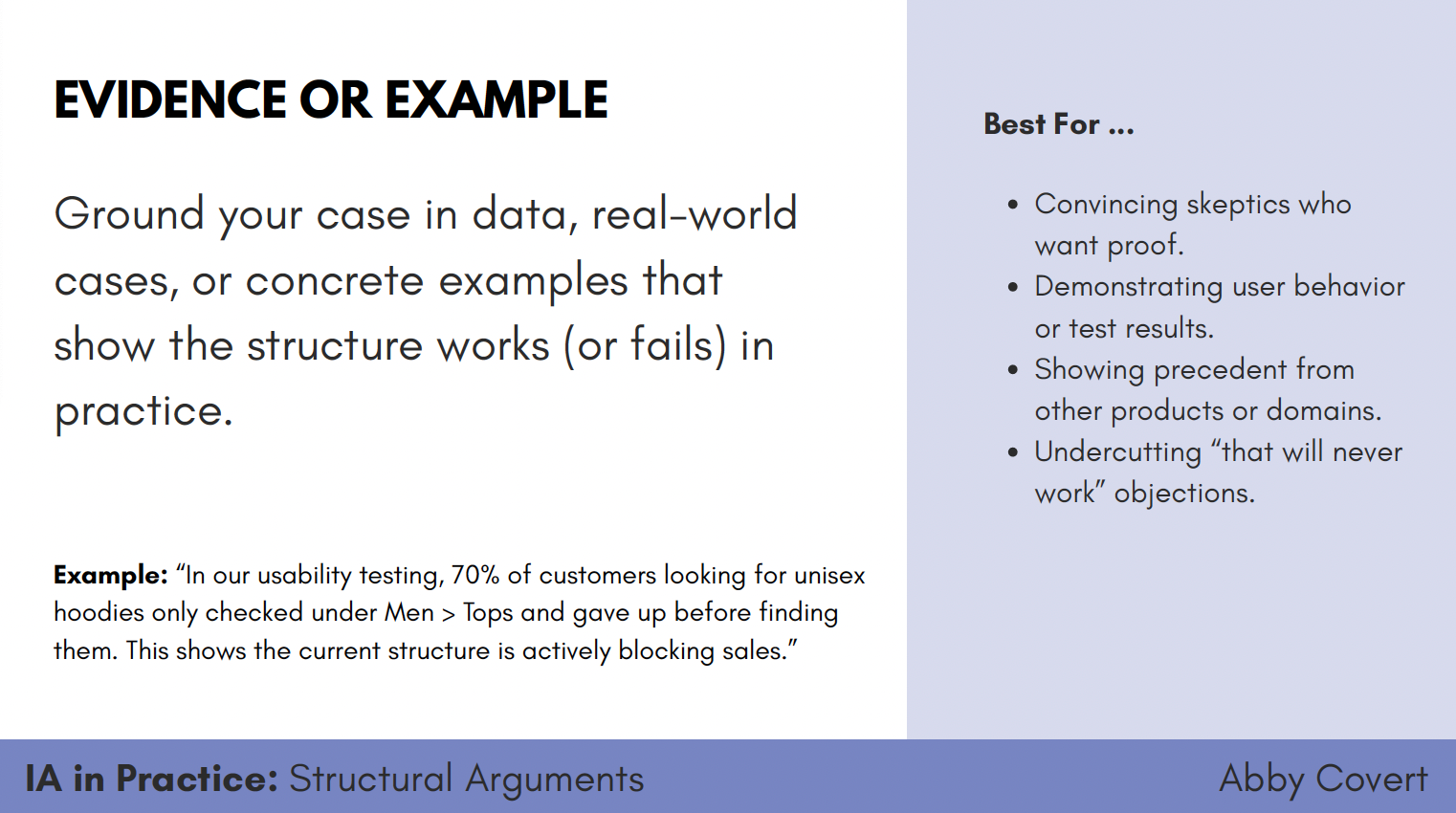 Course Example Slide 1
How is this course taught?
This is a self-paced eCourse built from a live workshop recording. Here's what's included:
- Workshop recording: A hands-on session led by Abby Covert, working through two competing structural proposals for a real-world scenario (approximately 90 minutes)
- Course deck: The slide deck from the live workshop session, available as a download
- Decision flowchart: "Check Yourself Before You Wreck Yourself" -- a printable guide to knowing when your argument is ready to make
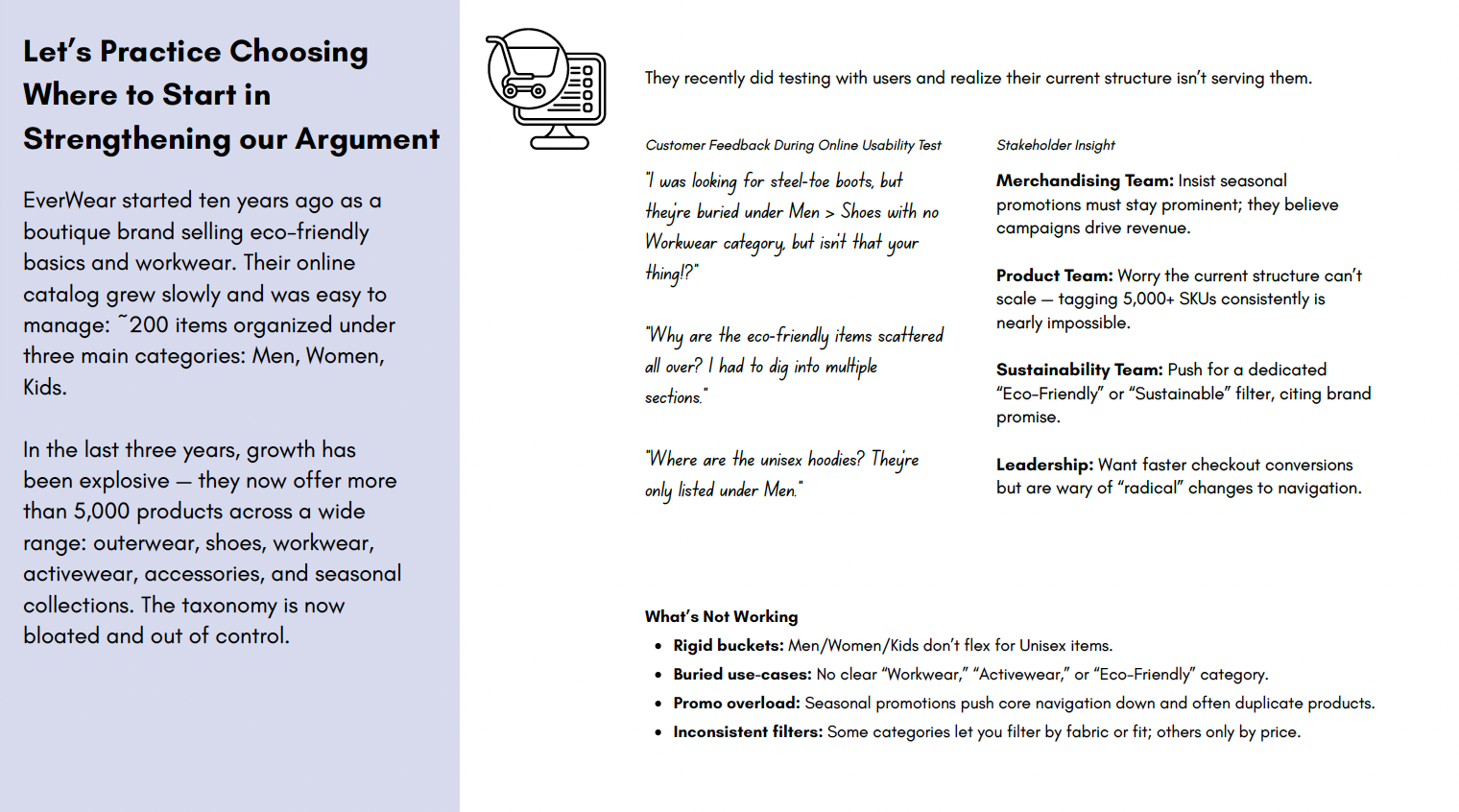 Course Example Slide 2
Who was this course designed for?
- You're the person who gets pulled in when a structure isn't working and no one can agree on what to do about it
- You do IA, content strategy, UX, information design, or knowledge management -- or some blend of all of them
- You've built proposals that got picked apart in review, and you want to know how to hold your ground better
- You're working on taxonomy changes, navigation redesigns, content reorganization, or system restructuring
- You're tired of decisions being made on preference or politics instead of reasoning
- You want to be able to explain not just what you built, but why it's right
- Job titles you might have: Information Architect, Content Strategist, UX Designer, Knowledge Manager, Product Designer, Systems Thinker, Digital Experience Designer
- You've been doing this kind of work for years, maybe just not under these names
Course Outline
What Argumentation Actually Is
A grounding in what structural argumentation means in an IA context, and why it's different from just "making your case." This section covers why arguments break down and what keeps them on track.
When Arguments Are Needed
The five most common situations that call for a structural argument: structural changes, resource requests, priority decisions, process improvements, and system design. You'll recognize all of them.
Types of Arguments
A breakdown of five argument types you can draw from: evidence-based, structural or definitional, trade-off, constraint, and user mental model. Each type is explained with a practical example so you know when to reach for it.
Approaches to Strengthening Your Argument
Five concrete approaches for pressure-testing what you've built before you present it: creating an alternative, digging into user interpretation, running a structural check, taking the implementation reality test, and going into failure mode.
Workshop: Argue for Your Solution
A hands-on exercise using two competing proposals for a real structural problem. You'll work through the decision framework and practice building an argument that's ready to defend.

Who is guiding this course?
"When you can't argue clearly for your structure, someone else's opinion wins by default. This course is about changing that." - Abby Covert
A community organizer, information architect and sensemakers with twenty years experience helping others make the unclear, clear.
