
Change Management
What is this course about?
You did the structural work. You redesigned the taxonomy, migrated the platform, or rolled out the new workflow. And then nothing actually changed.
This is one of the most frustrating patterns in information architecture work: good decisions that don't stick. Not because the logic was wrong, but because the human side of change was treated as someone else's problem.
This course is about that gap. It covers what change management actually means in IA practice, why rollouts fail even when the structure is sound, and what it looks like to support people through a shift in how they make sense of their work. If you've ever watched a well-designed system get quietly abandoned, this course was built for you.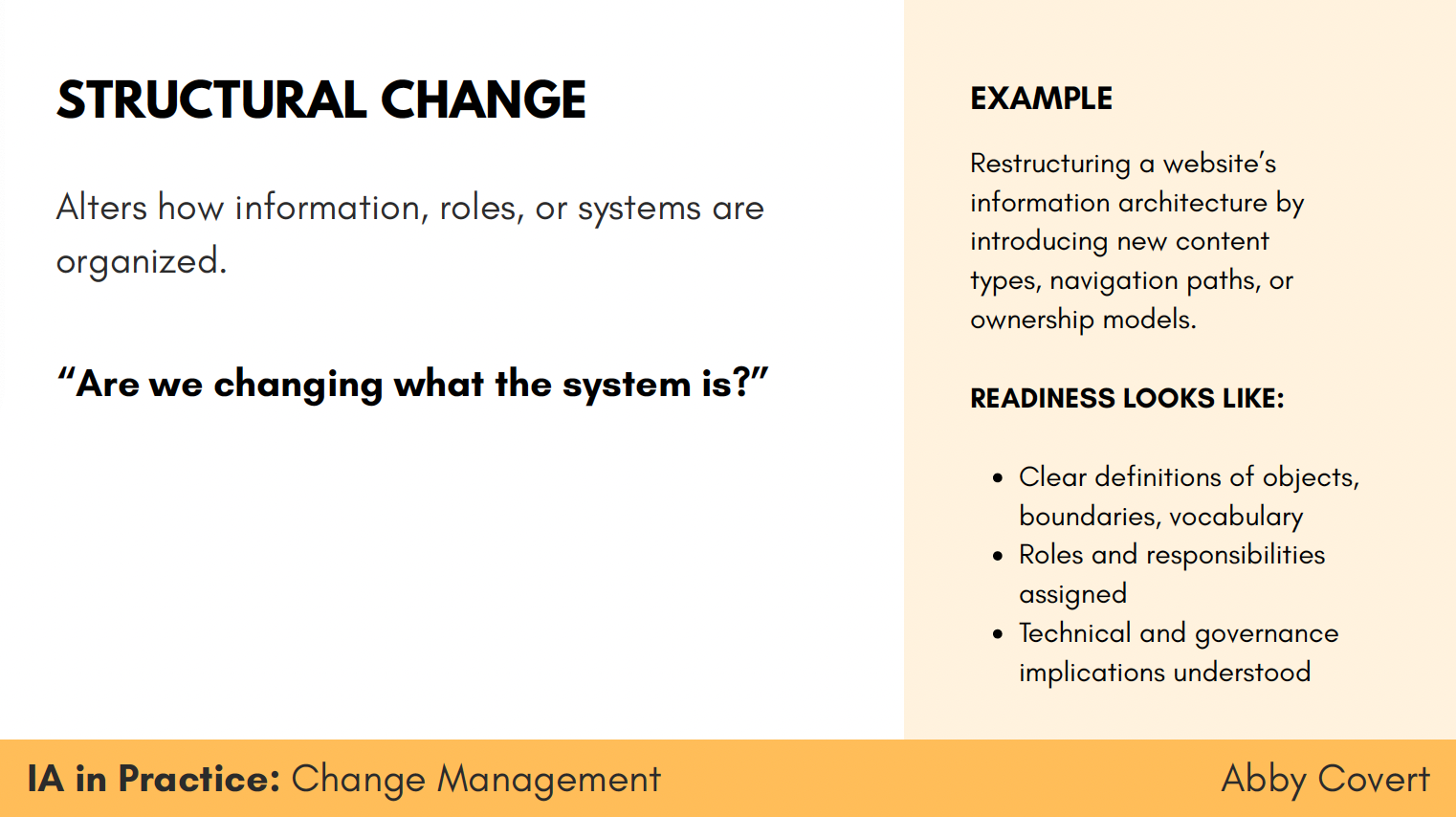 Course Example Slide 1
What is the learning objective of this course?
By the end of this course, you will be able to diagnose what kind of change you are dealing with, identify where support is missing, and choose a targeted approach to help people actually adopt a new way of working.
This includes being able to:
- Tell the difference between structural, process, behavioral, and cultural change, and understand why each one requires different support
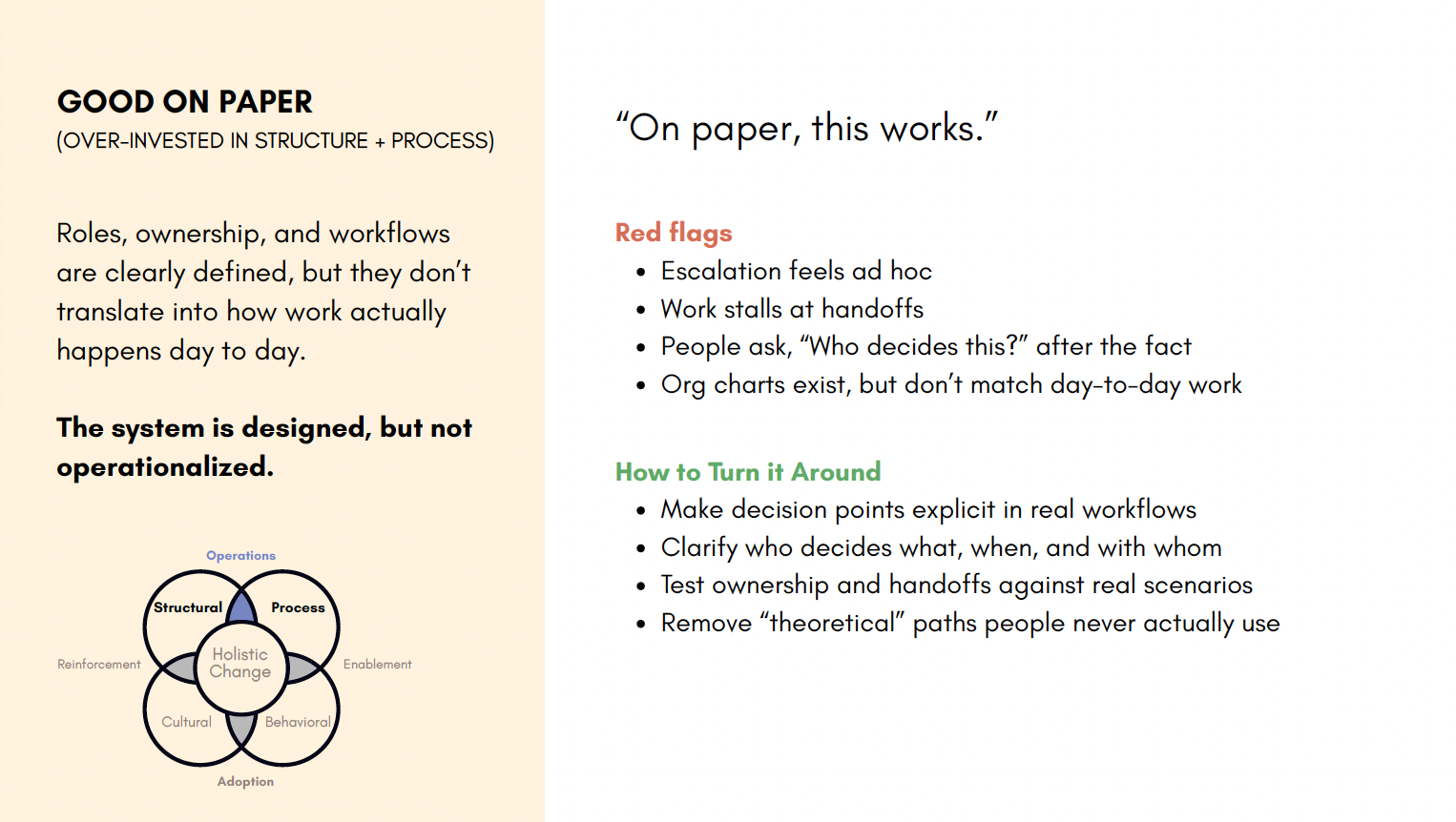
- Recognize common failure patterns by name, including when a rollout is "good on paper" but not operational, or when people are complying without actually changing
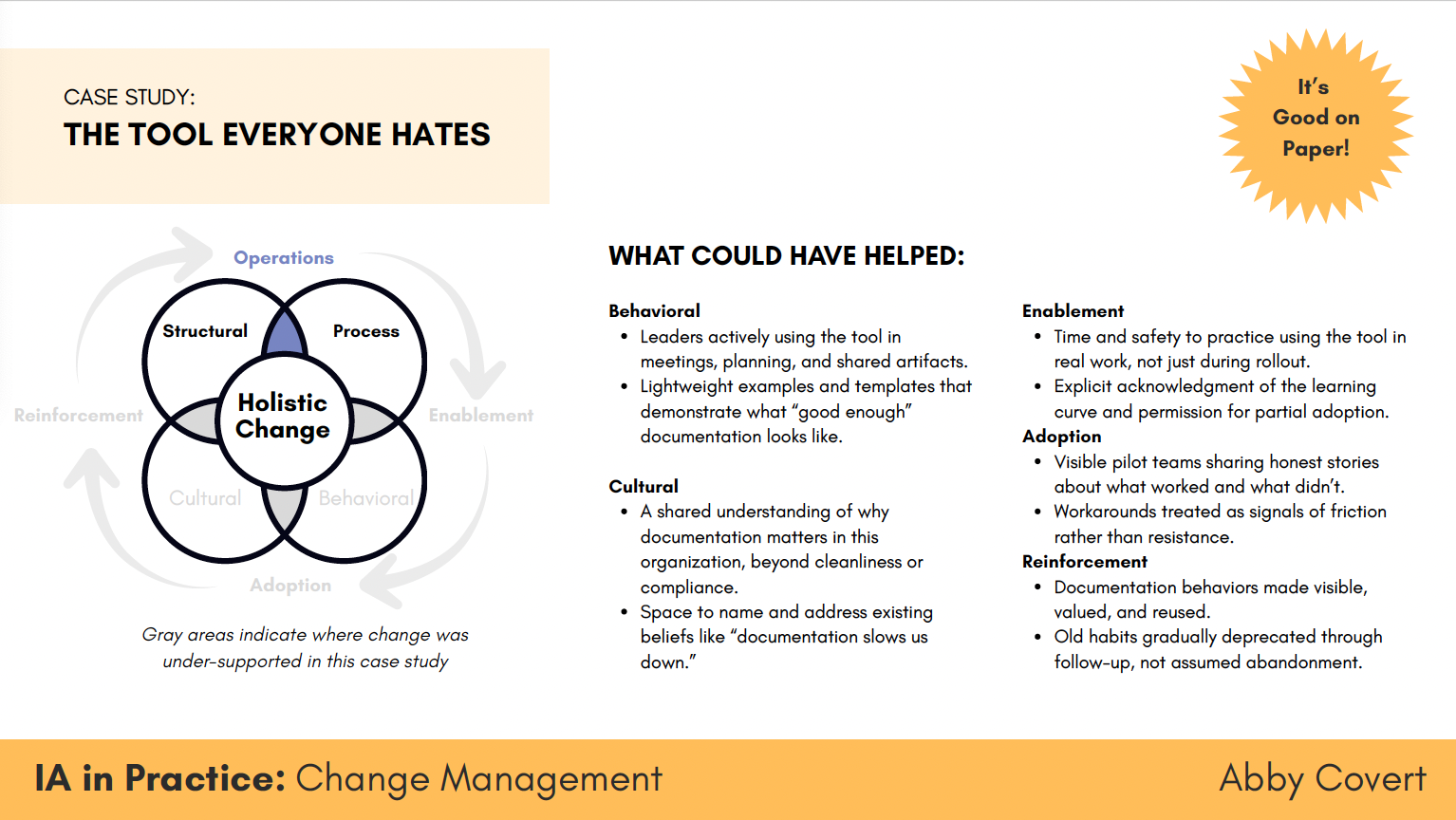
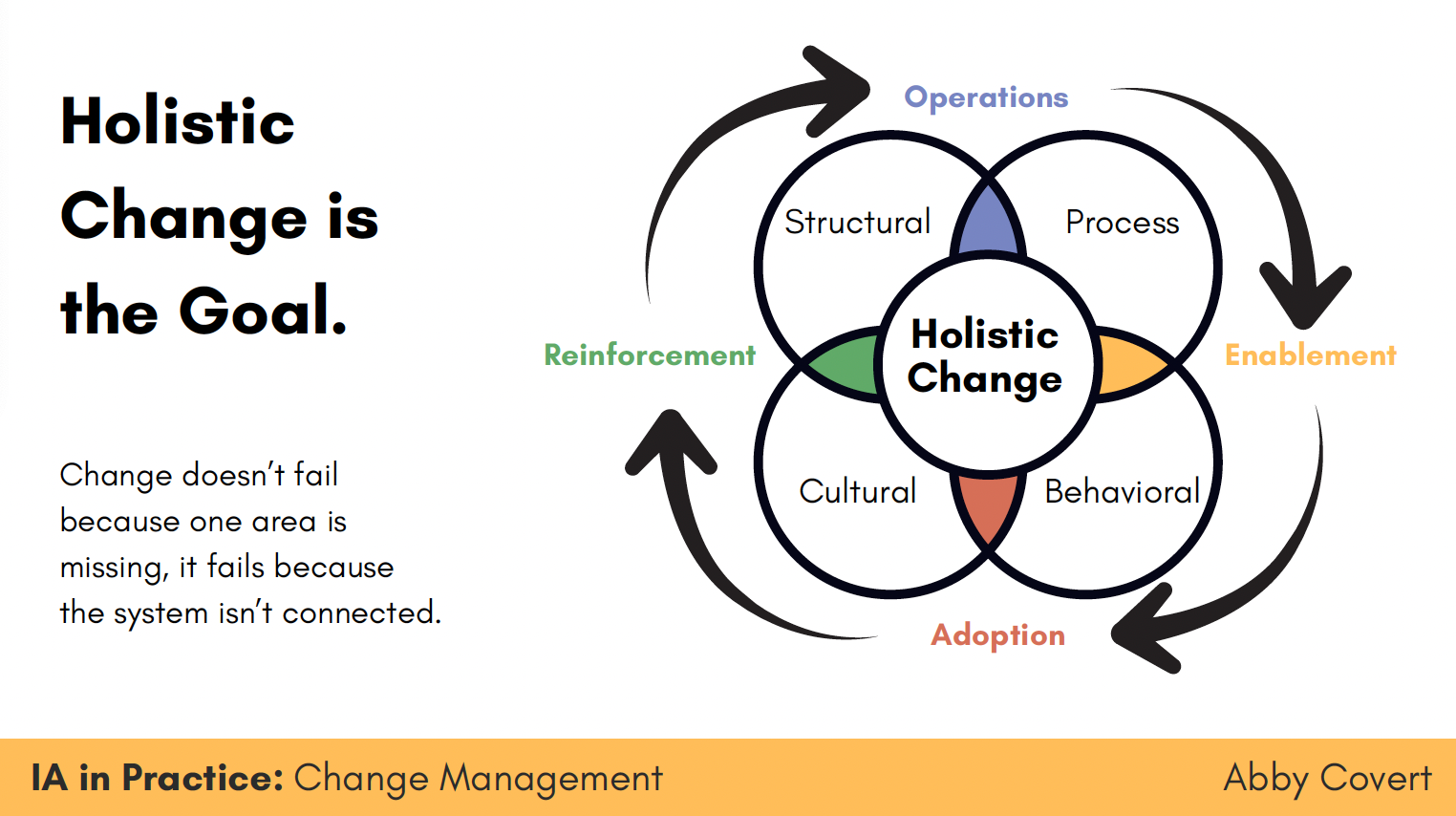
- Use a holistic change model to spot where your effort is uneven and where the gaps are
- Choose specific, situational approaches rather than defaulting to more documentation or another announcement
- Apply these skills to a real-world case study and defend your reasoning
 Course Example Slide 2
How is this course taught?
This is a self-paced eCourse built from a live workshop recording. Here's what's included:
- Workshop recording featuring instruction, case study analysis, and a structured peer practice exercise
- Slide deck used in the live session, available for download and reuse in your own work
- The session covers why change management matters in IA, a four-part typology of change, a holistic change model, five named failure archetypes with red flags and recovery moves, five situational approaches mapped to specific gap types, and a full case study walk-through with a group practice exercise
 Course Example Slide 3
Who was this course designed for?
This course was built for people who are already doing structural and systems work and keep running into the same wall: good work that doesn't land.
You might be a good fit if:
- You work in information architecture, content strategy, knowledge management, or a related field
- You've led or supported a migration, taxonomy rollout, governance change, or platform transition
- You've felt responsible for a change that technically succeeded but culturally failed
- You're often the person who sees the structural problem before anyone else does
- You're tired of being handed a launch date and no plan for what comes after
- You want language for what you're already doing intuitively, so you can talk about it with stakeholders and teammates
- You hold titles like Information Architect, Content Strategist, UX Lead, Knowledge Manager, Digital Workplace Lead, Intranet Manager, or Enterprise Content Manager
- You work in-house at a mid-to-large organization, or as a consultant on complex IA and content projects
 Course Example Slide 4
Course Outline
Why Change Management Matters in IA
When your users are stuck in their ways, stakes are high, multiple groups are affected differently, or trust is already broken, structural change alone won't get the job done. This section frames the core problem.
What Change Management Is
A working definition grounded in sensemaking: change management is how you help people move from their current way of making sense to a new one. Includes the top use cases in IA work, from taxonomy rollouts to platform migrations to governance shifts.
Types of Change
A four-part framework covering structural, process, behavioral, and cultural change. Each type comes with a diagnostic question, a real-world IA example, and a readiness checklist. The section closes with the argument that holistic change requires all four to be connected.
Archetypes
Five named failure patterns that smart practitioners fall into when support is uneven, including Good on Paper, Compliance Theater, Quiet Rebellion, Values Gap, and Mandated Heroics. Each archetype includes red flags to watch for and concrete ways to turn it around.
Case Study
A detailed walk-through of a real scenario, a documentation tool rollout that was structurally and procedurally sound but culturally and behaviorally under-supported. The case study maps gaps using the holistic change model and identifies what could have helped.
Approaches
Five situational approaches for moving forward when you've identified a gap: Start with Why, Find Champions, Make the Change Visible, Plan for Practice, Address the Losses, and Connect to Daily Reality. Each is paired with the gap types it addresses best and a signal for when to reach for it.

Who is guiding this course?
"Change often fails not because people skipped steps, but because they over-invested in the parts they're most comfortable with. This course gives you a way to see the whole picture and figure out what actually needs to happen next." — Abby Covert
A community organizer, information architect and sensemakers with twenty years experience helping others make the unclear, clear.
