
Proposing a Return on Investment
What is this course about?
You do work that matters. But if you can't show what got better, it's hard to protect that work, get resources for it, or bring others along. This course is about learning to measure and communicate the value of information architecture and sensemaking work in terms that stick.
If you've ever been asked to justify a naming project, explain why a taxonomy rewrite was worth the time, or defend an IA decision to someone who just wants a number, this course is for you. ROI in sensemaking isn't just about dollars. It's about time saved, risk avoided, trust built, and capability grown. This course helps you see all of it clearly and talk about it with confidence.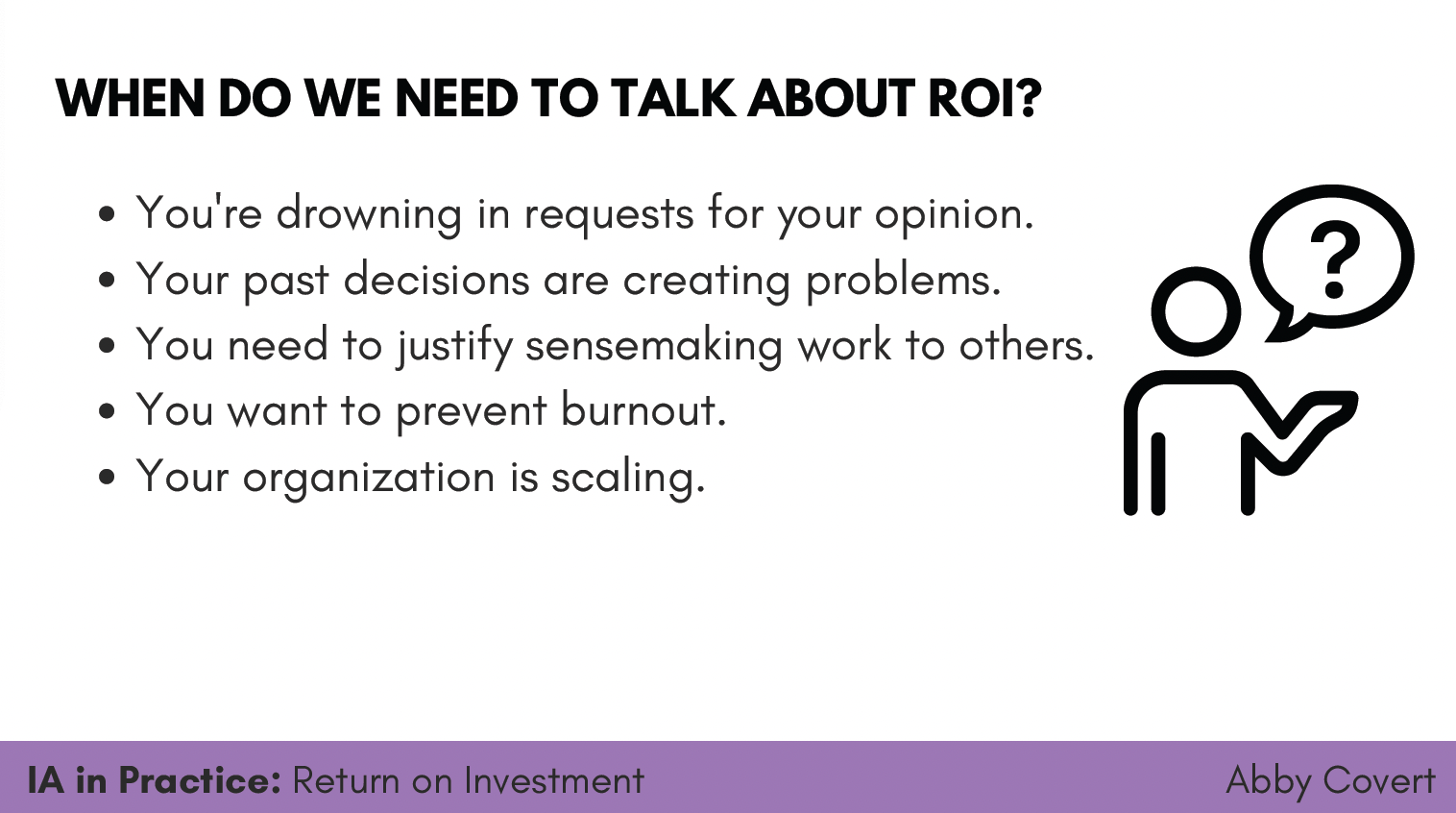 Course Example Slide 1
What is the learning objective of this course?
By the end of this course you will be able to identify the type of return your sensemaking work is creating, score it honestly, and choose a strategy to strengthen it.
That means you'll be able to:
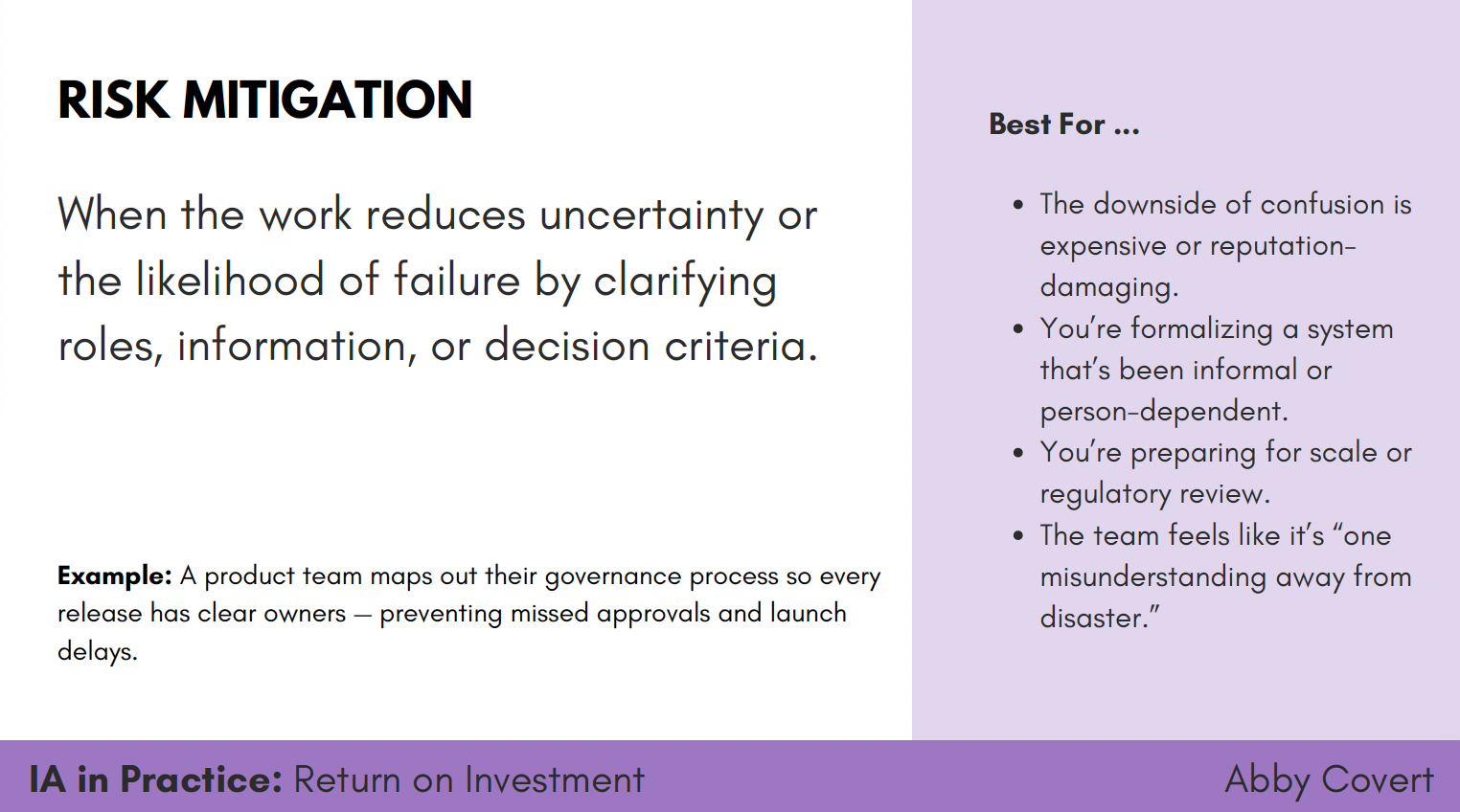
- Define the six types of ROI that apply to sensemaking and IA work: time saving, cost reduction, capability building, risk mitigation, profit growth, and reputation and perception
- Identify which use cases, including naming consistency, information organization, process documentation, and framework creation, map to which return types
- Score a project's expected ROI before it starts, not just after
- Choose the right approach to prove value based on your specific situation: a pilot project, a pain point focus, systems thinking, or a user journey lens
- Spot warning signs that a sensemaking investment may not pay off the way you expect
 Course Example Slide 2
How is this course taught?
This is a self-paced eCourse built from a live workshop recording. Here's what's included:
- Workshop recording: Abby Covert walks through the full ROI framework, including the six return types, four case studies, and a decision tree for choosing where to start. Two hands-on practice scenarios are included so you can try the scoring method yourself.
- Course deck: The full slide deck used in the workshop is included as a download.
- Decision tree tool: A printable flowchart to help you decide which ROI approach fits your situation.
 Course Example Slide 3
Who was this course designed for?
- You do work that involves organizing, naming, structuring, or documenting information, and you've struggled to explain why it matters to people who hold the budget or set priorities
- You've felt the sting of a project being called "housekeeping" when you knew it saved real time or prevented real problems
- You're an information architect, content strategist, knowledge manager, UX researcher, operations lead, or systems thinker who works across teams
- You've been asked "what's the ROI on that?" and felt unprepared to answer
- You're trying to protect your practice from being cut, deprioritized, or absorbed into a role that doesn't understand what you actually do
- You want to move from gut-feeling defenses of your work to structured, repeatable arguments
- You're the person others call when things get complicated, and you're ready to start charging what that costs
Course Outline
What is ROI?
A grounded definition of return on investment as it applies to sensemaking work, plus a critical warning: if you can't measure what got better, you might have made things worse.
Use Cases for ROI in Sensemaking
Where does ROI show up most often in IA practice? This section covers the four most common contexts: naming and language consistency, information organization, process documentation, and framework creation.
The Six Types of Return
A close look at each return type, including when each one applies, what kinds of projects it fits best, and a real-world example for each. Time saving, cost reduction, capability building, risk mitigation, profit growth, and reputation and perception are all covered in depth.
Case Studies
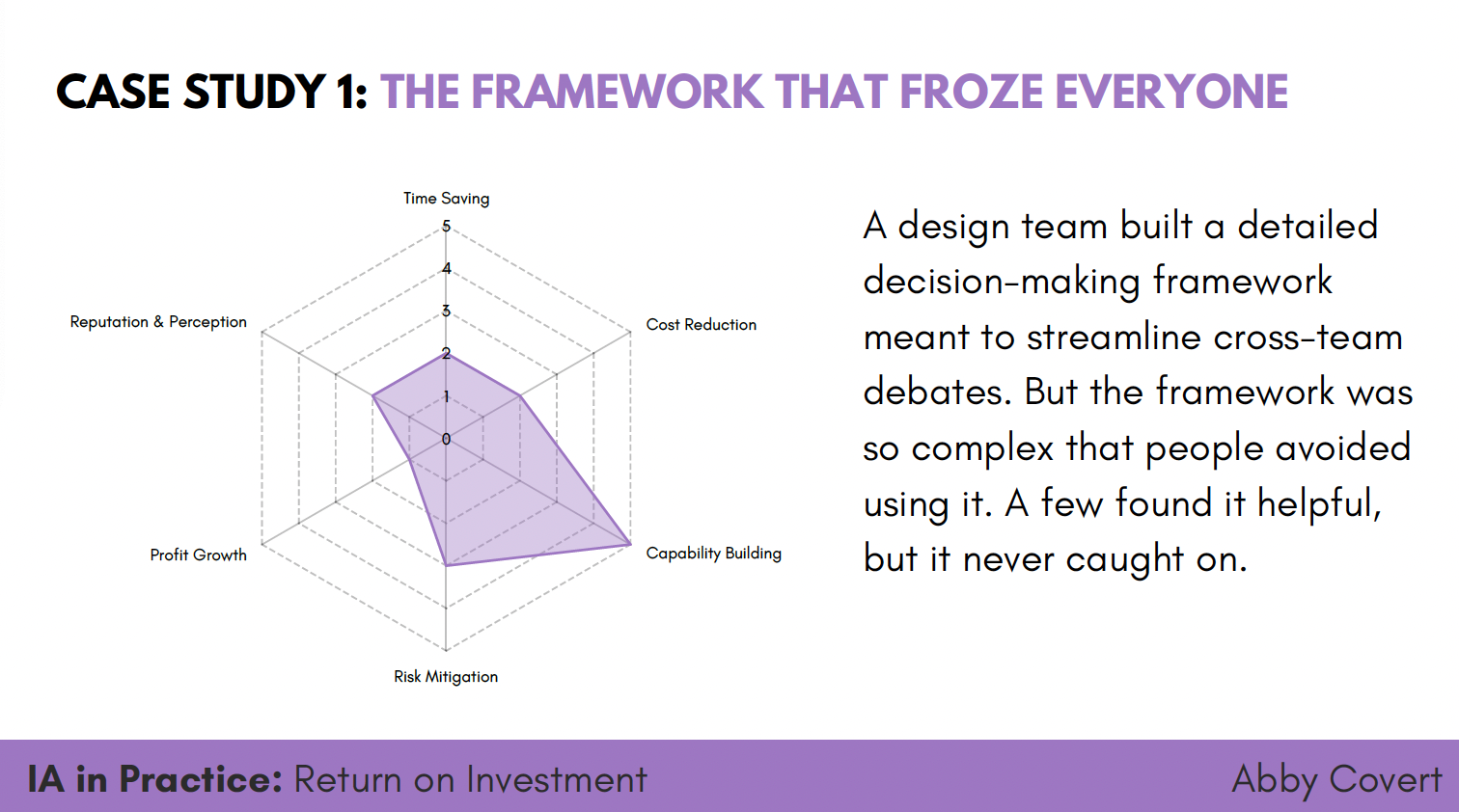
Four real scenarios scored using the radar model: a framework that froze everyone, a taxonomy that saved time, a shared vocabulary that spread across teams, and a process map no one read. Each one shows you how to assess a project's return before and after the fact.
Approaches to Strengthening Your ROI
Four strategies for making your sensemaking investment pay off more reliably: planning a pilot project, focusing on pain points, applying systems thinking, and looking at the user journey. Includes a decision tree for choosing the right approach for your situation.
Workshop Practice
Two hands-on scenarios where you rate expected ROI across all six types and decide on a strengthening approach. First as a group, then in pairs. These are the exercises that make the concepts stick.

Who is guiding this course?
"Most sensemakers I know are doing work that creates real value and have almost no language for proving it. This course gives you that language, and then makes you practice using it on cases that actually feel familiar." — Abby Covert
A community organizer, information architect and sensemakers with twenty years experience helping others make the unclear, clear.
